Sapphire FUE
This page- Removing grafts
- Same as FUE
- Making the openings
- Channels made with a sapphire blade
- Placing the grafts
- Fine forceps
- Shaving
- Usually needed
- Often chosen for
- Same uses as FUE
Also known as: sapphire blade FUE · sapphire hair transplant
Sapphire FUE is a type of FUE hair transplant. Your grafts are removed one by one, as in FUE, and the small openings for the new hairs are made with a sapphire blade instead of a steel one. Most patients stay 2 to 3 days.
Anesthesia
Local
Time abroad
2 to 3 days
Results
6 to 12 months
How it compares
Sapphire FUE, FUE and DHI all remove grafts the same way, one follicle at a time. They differ in how the small openings for the new hairs are made and how the grafts are placed.
No large, well-designed study shows that one reliably gives better growth than the others. The right method depends on your hair, your donor area and your surgeon's experience with it. If you're not sure which technique is right for you, FUE vs DHI, how to choose explains the differences.
Who it suits
Sapphire FUE is used for the same things as FUE. The basic requirements are the same as for any hair transplant: hair loss that has settled into a stable pattern, and enough healthy donor hair.
Larger areas
Most hair loss patterns
Your surgeon recommends the technique after examining your scalp.
Step by step
Sapphire FUE is done under local anesthesia, and you go back to your hotel the same day.
The surgeon examines your scalp, confirms the graft plan and draws your new hairline.
The donor area, and often the recipient area, is shaved. Local anesthetic numbs the scalp.
Follicles are removed one by one from the back and sides of your head with a tiny punch, as in FUE.
Small openings are made with a sapphire blade where the new hair will grow. This sets the angle, direction and density.
Grafts are placed into the channels with fine forceps.
The donor area is dressed, and you get written aftercare instructions.
Recovery after Sapphire FUE follows the same path as FUE, because only the blade for the openings is different.
Timings are typical, not promised.

Moves your own hair follicles to areas that are thinning or bald.
Removes grafts one by one from the donor area and places them where hair is thinning.
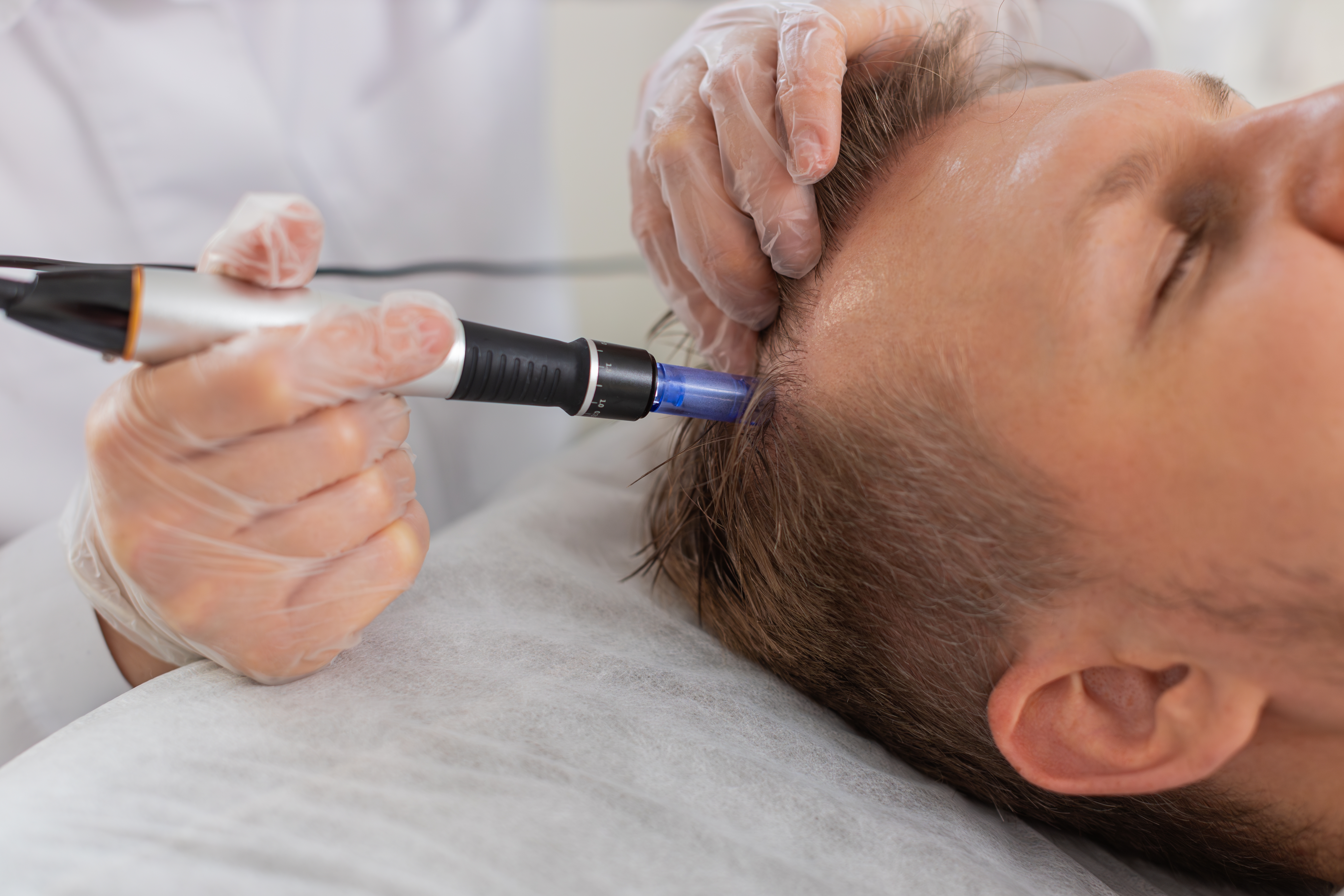
A type of FUE in which a pen-like implanter opens each channel and places the graft in one move.
FAQ
Not necessarily. In a 2023 study of 12 men in the Journal of Craniofacial Surgery, a handmade razor blade caused less tissue damage than a sapphire blade. A larger 2026 study in the Journal of Maxillofacial and Oral Surgery followed 1,000 patients who weren't randomly assigned to a blade, and found higher graft survival with sapphire blades. Ask your surgeon which blade they use, and why.
Usually, as with FUE. The donor area is shaved, and often the recipient area too.
References
Determination of Scalp Vascular Topography by Laser Doppler Flowmetry and Comparison of Vascular Damage by Different Blades in Hair Transplantation
Journal of Craniofacial Surgery, 2023 · doi.org
Accuracy in Hair Repair: Assessing Sapphire FUE, Forceps Methods, and Treatment Times in Contemporary Hair Transplantation
Journal of Maxillofacial and Oral Surgery, 2026 · doi.org
Advancements in Graft Placement Techniques
Facial Plastic Surgery, 2023 · doi.org
Complications in follicular unit excision hair transplantation
Frontiers in Medicine, 2026 · pmc.ncbi.nlm.nih.gov